On this day in 2026, we must acknowledge a harsh reality: "backups" are no longer a safe haven for cybersecurity, but have become the primary target for hacker attacks.
With the weaponization of generative AI (GenAI), modern ransomware (Ransomware 3.0) is demonstrating unprecedented tactical intelligence. Although the dwell time in Networking is shorter, its destructive power has multiplied. Hackers no longer just encrypt your production environment; they now prioritize seeking out and deleting backup systems, wiping out snapshots, and even poisoning backup data, leaving enterprises in a desperate situation with no way out.
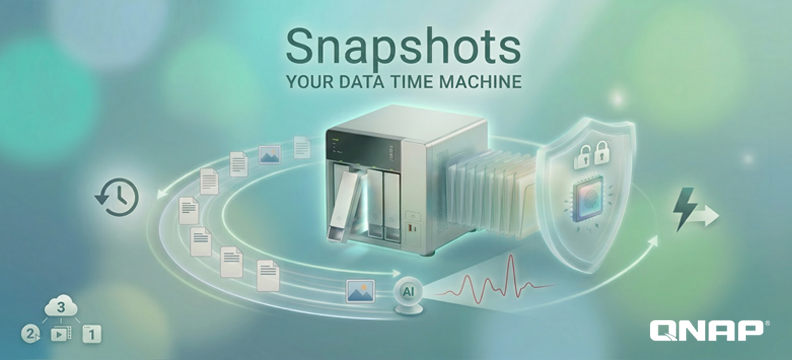
In the face of such threats, traditional backup strategies have become outdated. This article will delve into the two main pillars of building modern cyber resilience: Immutable Snapshots and Physical/Logical Air-Gapped Backups.
When backup software becomes an attack surface
According to the latest market threat report, over 90% of ransomware attacks attempt to destroy backup repositories. This has driven the storage and cybersecurity market to shift their technical paradigms, moving from the traditional RTO question of “How long will it take us to recover?” to “Are we sure our data still exists?” This is because storage systems are becoming more security-focused—they are no longer just simple data repositories, but have become critical defense points with built-in ransomware detection and prevention mechanisms. On the other hand, requirements related to Networking insurance (Cyber Insurance) have already started to list “immutable backups” as a prerequisite for underwriting or claims settlement.
In the era of AI vs. AI, even if traditional perimeter defenses (Firewall/EDR) block 99% of attacks, the remaining 1% can still be fatal. Therefore, "immutable" backups data are the key advantage for enterprises to refuse to pay ransoms at the negotiation table.
Core Technology One: Immutable Snapshots
What is "immutability"?
Simply put, it means "write once, read many" (WORM - Write Once, Read Many). Once data is written and locked, within the set retention period, no one—including System Management members, Root Permission owners, or even the QES software itself—can modify or delete these data.
In recent years, due to the widespread adoption of Object Lock, Object Lock based on the S3 API has become the standard for cloud and on-premises storage objects. Many modern high-speed storage arrays (All-Flash Arrays) model now integrate this feature directly at the underlying layer, eliminating the need for additional software layers. Furthermore, the information environment has introduced multi-factor authentication (MFA) enforced deletion. Even if a hacker obtains administrator credentials and wants to modify the immutability policy or forcibly delete snapshots, the system will trigger the "Four-eyes principle," requiring multiple people and multiple factors License before approval is granted. This ensures the undeletable characteristic of data.
Technical Core II: Physical and Logical Isolation (Air-Gapped Backups, Airgap Isolation Backup)
Traditional vs. modern Air-Gap are already very different. In the past, we thought of Air-Gap as removing the tape and locking it in a safe deposit box. Although this is effective, the recovery speed (RTO) is too slow and cannot meet modern business requirements. However, it can still serve as an offsite backup node and, in the event of Networking interruption and inability to recover, act as the last line of defense.
Modern "virtual air-gap" refers more to logical isolation and Networking layer blocking, including non-routable Networking (Non-routable Networks). We can store backups in a network segment completely isolated from the production environment, and only during the scheduled backup time will a specific secure channel be opened to transfer data for backup. Once the backup is complete, this specific secure channel is immediately closed, so hackers cannot access this isolated, unreachable golden backup area.
In addition, enterprises will also implement an isolated recovery environment (Cleanroom Recovery), using cloud resources to establish a separate secure clean area. Before restoring the backup data to the production environment, AI scanning and identification are first performed in the secure area to ensure there is no hidden malicious software.
From “Manual Disconnection” to “Intelligent Isolation”: The Evolution of Airgap+ Technology in Practice
After understanding the theory behind air-gapping, the most common practical challenge enterprises face is: “Do IT staff really have to go to the server room every day to plug and unplug Networking cables?” In an era of tight manpower, this is clearly unrealistic. Therefore, a new generation of backup protection technology has introduced the concept of “Active Air-Gap,” such as QNAP’s Airgap+ technology, which automates and smartens this concept.
The core logic of this technology lies in the concept of “Disconnected by default.” Unlike traditional firewalls that rely solely on rule-based software to block traffic, the modern Airgap+ integrates backup software (such as HBS 3) with the control layer of Networkingunit (Router or Switch). Only at the moment when a backup task is initiated will the system send a command to “wake up” the specific Networking interface (Link Up); once data transmission is complete, the Networking interface will be immediately shut down at the physical or logical layer (Link Down).
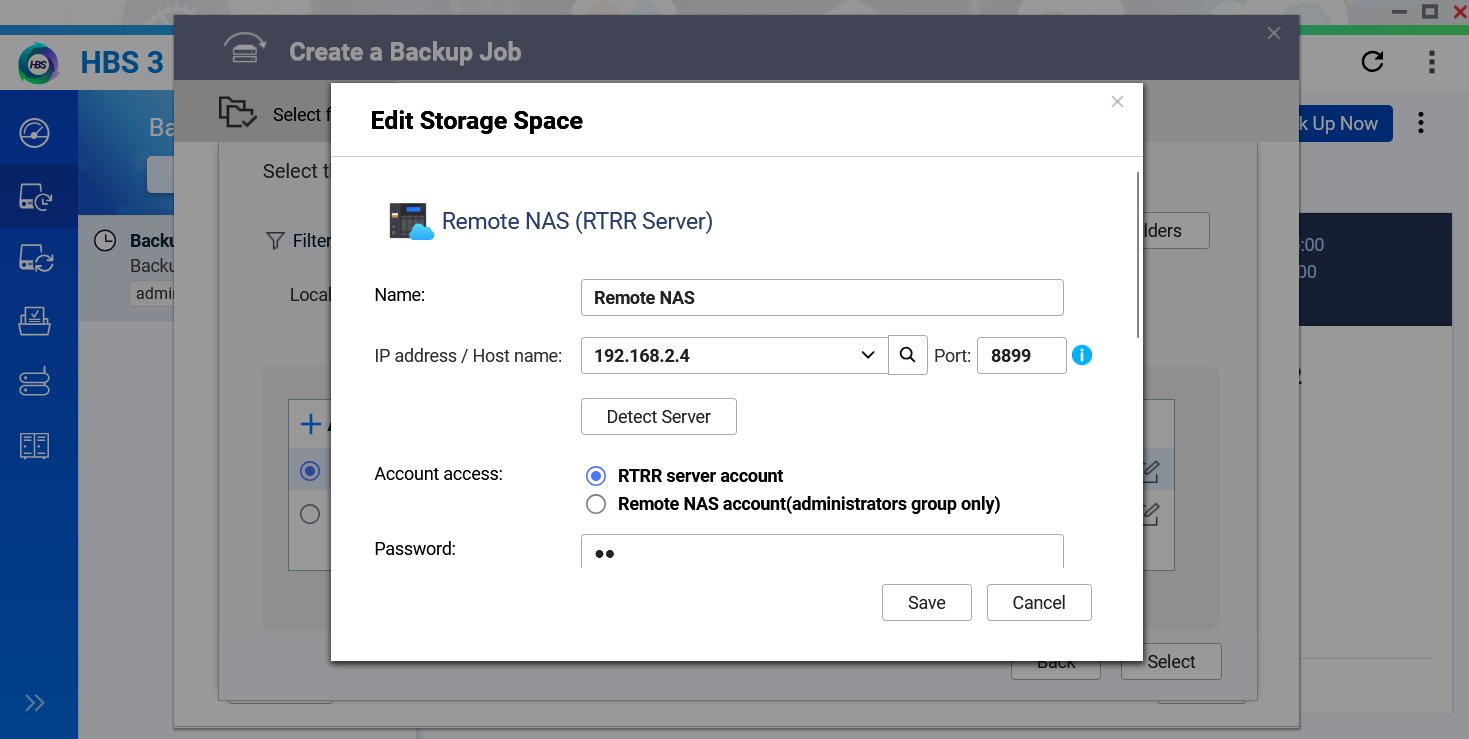
When setting up HBS backup and selecting remote NAS unit, you can conveniently enable the RTRR server. Scroll down on this page to find the Airgap+ option.
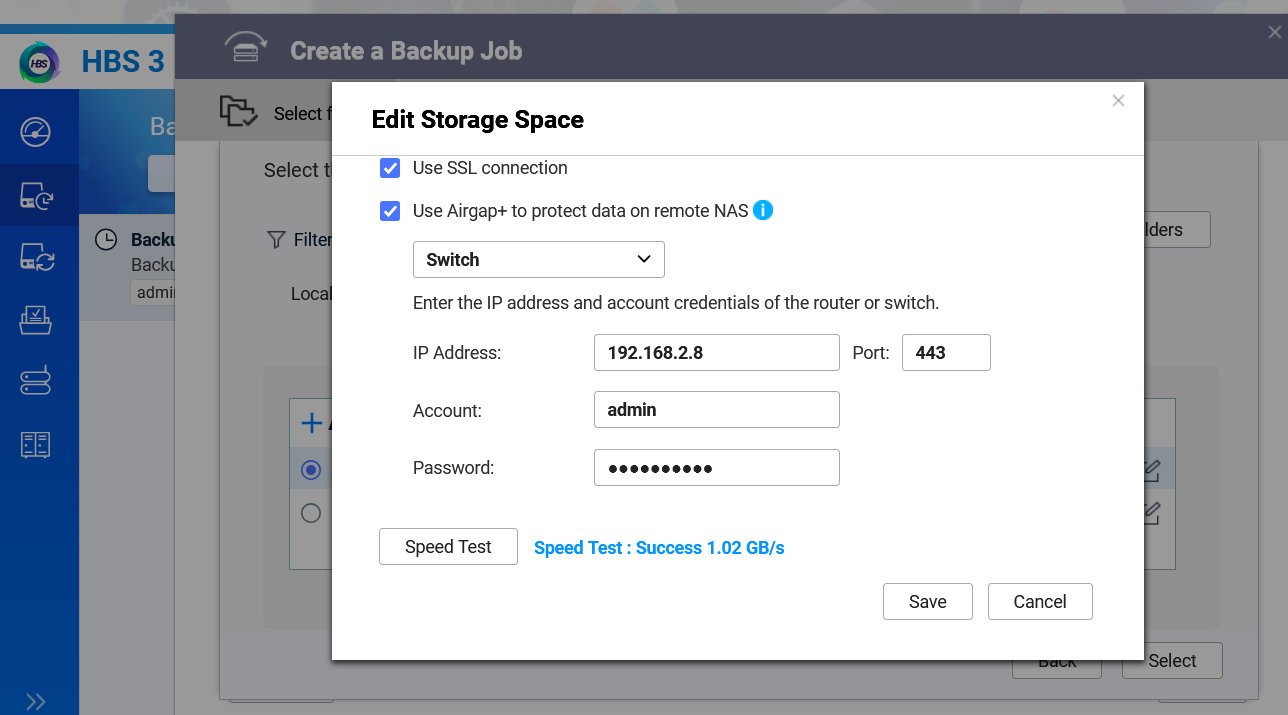
In the image, you can see that we selected a QNAP Switch supporting Airgap+. In this case, we chose the QSW-M3224-24T. You can see that the actual test speed in this case reached 1.02GB per second. The environment between the two devices is connected via 10GbE Networking, which makes the backup synchronization much more efficient.
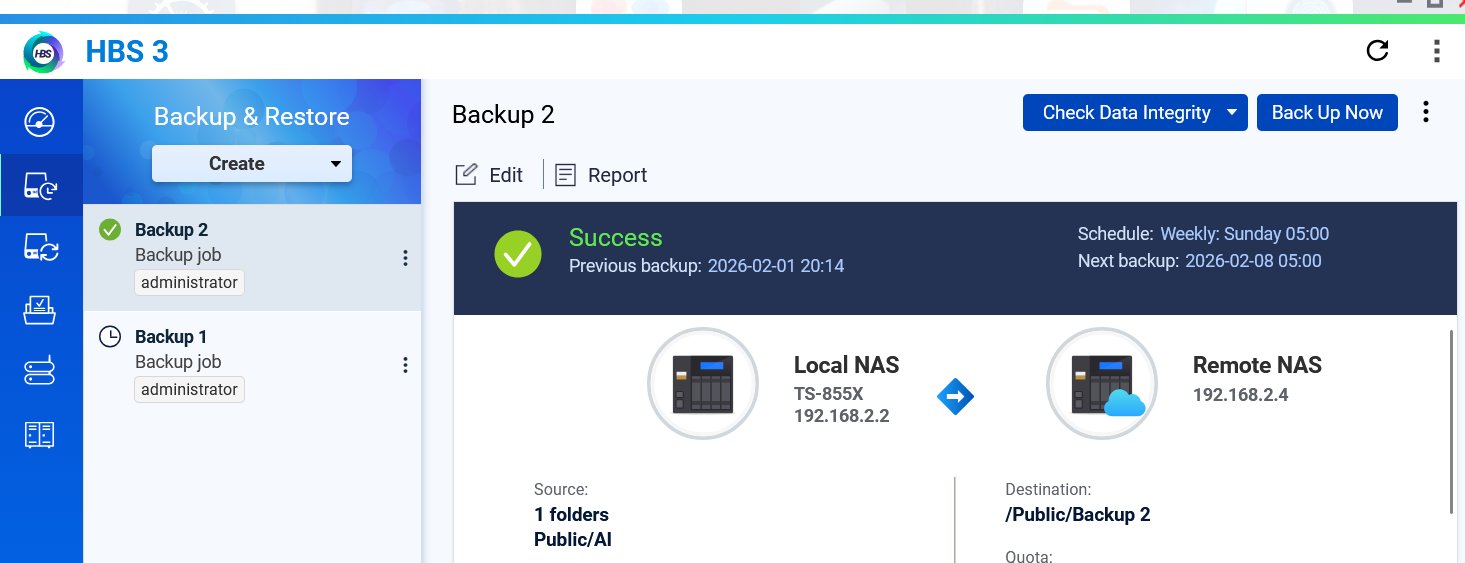
This design creates a “time window” that is difficult for hackers to cross, because for 99% of the time, the backup server is completely invisible on Networking (Invisible), making it undetectable by scanning tools and unreachable by ransomware software. By using QNAP Router or a supported QNAP switch, you can deploy this upgraded version of Airgap+ with even higher Security isolation.
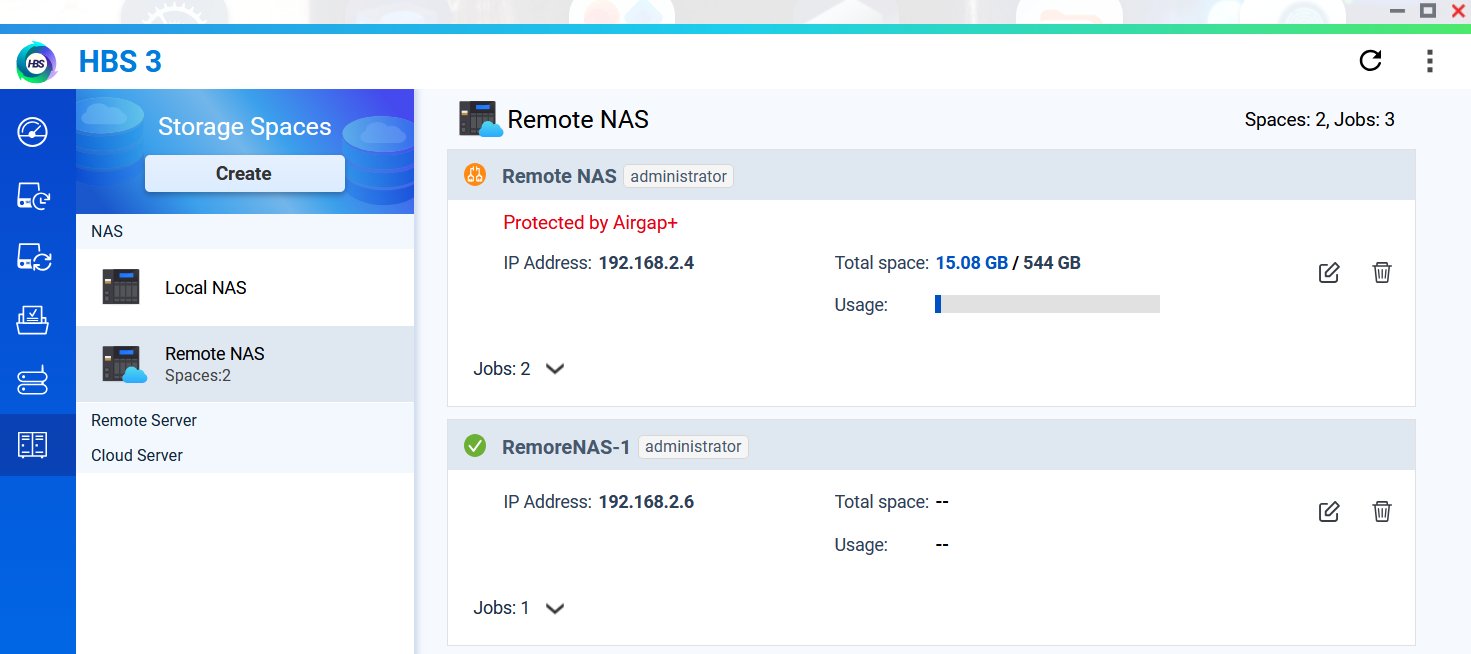
The protected NAS unit will be marked as protected in HBS 3. Even if you try to connect to this IP address, the system will not succeed, because it is hidden or blocked by Switch or Router.

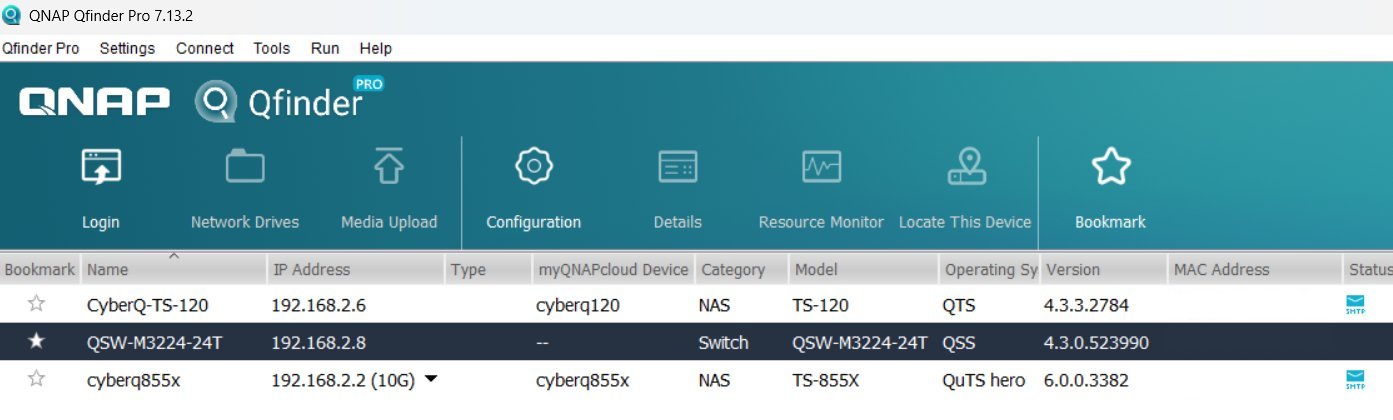
QNAP NAS unit protected by Airgap+ will not be visible on the internal network. As shown in the two images below, even QNAP's Qfinder Pro cannot find this NAS after the system backup has established the Airgap+ mechanism.
In addition, for environments with high Security requirements, an advanced architecture can even adopt the "Bridge Mode," which means we can add an intermediary bridge unit (Bridge NAS) that is not storagedata between the production environment and the backup vault. The production server can only access the intermediary unit, while the actual backup vault is hidden behind the intermediary unit, forming a "deep defense" that isolates the core backup area. Even if the production environment is completely compromised, attackers still cannot find a digital path to the core of the backup, which significantly enhances the ultimate data Security of the backup domain.
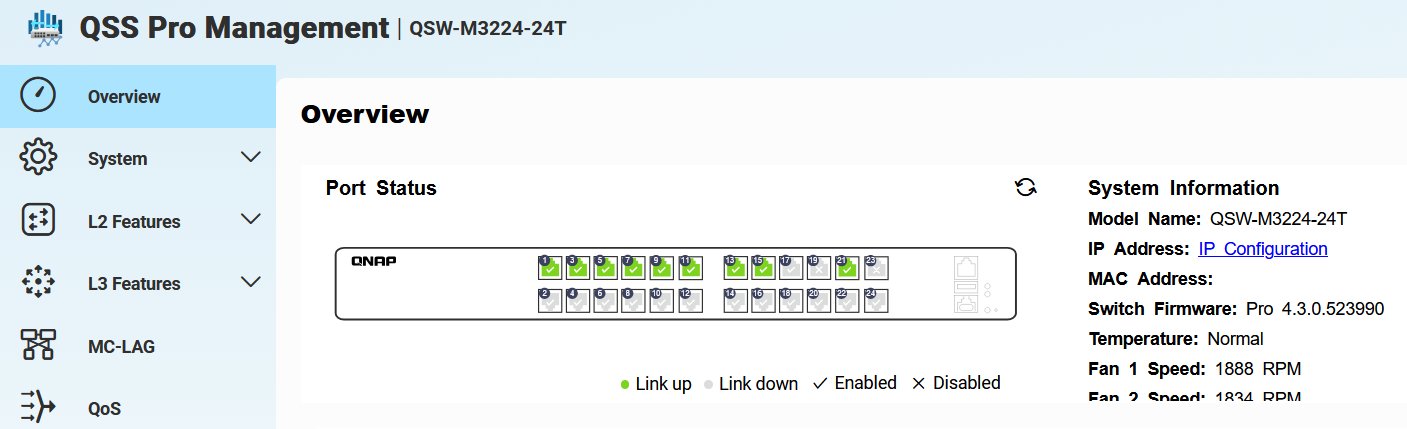
In this environment, the interface of the QNAP switch QSW-M3224-24T immediately displays that the NAS unit TS-855X is connected to ports 17, 19, and 23, all of which are shown as disconnected.
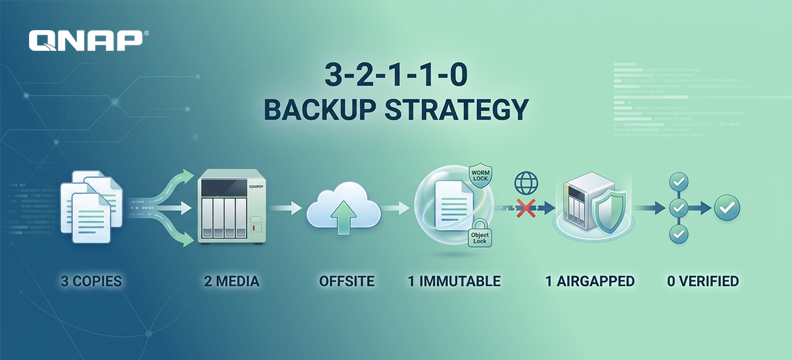
Practical strategy: Upgrade the 3-2-1 backup rule to the 3-2-1-1-0 rule
The previous “3-2-1 rule” (3 copies, 2 types of media, 1 offsite) has proven insufficient in the face of targeted attacks. Many enterprises, when implementing business information and Networking environments, have already begun to promote organizational upgrades to the “3-2-1-1-0 rule.” What is this?
That is, in an information environment, you should have at least:
3 copies of data.
2 different storage media.
1 copy to be stored off-site (Offsite).
1 offline or immutable (Offline / Immutable) copy, which is currently a key focus in the market.
0 errors (automated verification ensures backup is readable and restorable).
Trust is good, but verification and locking are more important
As the global cybersecurity landscape becomes increasingly blurred, identity verification may be stolen and vulnerabilities may be exploited by zero-day attacks (Zero-day). Only Immutable Snapshots and Air-Gap Backups provide the new generation of digital gold vaults, ensuring that in an era of rampant ransomware, enterprise core data remains intact and unharmed.
Op deze dag in 2026 moeten we een harde realiteit erkennen: "back-ups" zijn niet langer een veilige haven voor cybersecurity, maar zijn het primaire doelwit geworden van hackeraanvallen.
Met de bewapening van generatieve AI (GenAI) toont moderne ransomware (Ransomware 3.0) ongekende tactische intelligentie. Hoewel de verblijftijd in Netwerken korter is, is de vernietigende kracht ervan vermenigvuldigd. Hackers versleutelen niet langer alleen je productieomgeving; ze geven nu prioriteit aan het opsporen en verwijderen van back-upsystemen, het wissen van snapshots en zelfs het vergiftigen van back-updata, waardoor bedrijven in een wanhopige situatie zonder uitweg terechtkomen.
Gezien dergelijke bedreigingen zijn traditionele back-upstrategieën verouderd. Dit artikel gaat dieper in op de twee belangrijkste pijlers voor het opbouwen van moderne cyberweerbaarheid: Onveranderlijke Snapshots en Fysiek/Logisch Air-Gapped Back-ups.
Wanneer back-upsoftware een aanvalsvlak wordt
Volgens het nieuwste marktrapport probeert meer dan 90% van de ransomware-aanvallen back-uprepositories te vernietigen. Dit heeft de opslag- en cybersecuritymarkt ertoe aangezet hun technische paradigma's te verschuiven, van de traditionele RTO-vraag "Hoe lang duurt het voordat we herstellen?" naar "Zijn we zeker dat onze data nog bestaat?" Dit komt doordat opslagsystemen steeds meer op veiligheid zijn gericht—ze zijn niet langer alleen eenvoudige dataopslagplaatsen, maar zijn kritieke verdedigingspunten geworden met ingebouwde ransomware-detectie en -preventiemechanismen. Aan de andere kant zijn eisen met betrekking tot Netwerkverzekeringen (Cyberverzekering) al begonnen "onveranderlijke back-ups" als voorwaarde voor acceptatie of schadeafhandeling te vermelden.
In het tijdperk van AI tegen AI, zelfs als traditionele perimeterverdedigingen (Firewall/EDR) 99% van de aanvallen blokkeren, kan de resterende 1% nog steeds fataal zijn. Daarom zijn "onveranderlijke" back-updata het belangrijkste voordeel voor bedrijven om losgeldbetalingen aan de onderhandelingstafel te weigeren.
Kerntechnologie Eén: Onveranderlijke Snapshots
Wat is "onveranderlijkheid"?
Simpel gezegd betekent het "één keer schrijven, vaak lezen" (WORM - Write Once, Read Many). Zodra data is geschreven en vergrendeld, kan binnen de ingestelde bewaartermijn niemand—ook niet leden van Systeembeheer, Root-rechtenhouders of zelfs de QES-software zelf—deze data wijzigen of verwijderen.
In de afgelopen jaren is door de brede toepassing van Object Lock, Object Lock op basis van de S3 API, de standaard geworden voor cloud- en on-premises opslagobjecten. Veel moderne high-speed opslagarrays (All-Flash Arrays) integreren deze functie nu direct op het onderliggende niveau, waardoor extra softwarelagen overbodig zijn. Daarnaast is in de informatieomgeving multi-factor authenticatie (MFA) voor verwijdering geïntroduceerd. Zelfs als een hacker beheerdersreferenties verkrijgt en het onveranderlijkheidsbeleid wil wijzigen of snapshots geforceerd wil verwijderen, zal het systeem het "vier-ogen-principe" activeren, waarbij meerdere personen en meerdere factoren Licentie nodig zijn voordat goedkeuring wordt verleend. Dit waarborgt het niet-verwijderbare karakter van data.
Technische Kern II: Fysieke en Logische Isolatie (Air-Gapped Back-ups, Airgap Isolatie Back-up)
Traditionele versus moderne Air-Gap zijn al heel verschillend. Vroeger dachten we bij Air-Gap aan het verwijderen van de tape en deze in een kluis leggen. Hoewel dit effectief is, is de herstelsnelheid (RTO) te traag en voldoet het niet aan de moderne zakelijke eisen. Toch kan het nog steeds dienen als offsite back-upnode en, bij Netwerkonderbreking en onvermogen tot herstel, fungeren als laatste verdedigingslinie.
Moderne "virtuele air-gap" verwijst meer naar logische isolatie en Netwerklaagblokkering, waaronder niet-routeerbare Netwerken (Non-routable Networks). We kunnen back-ups opslaan in een netwerksegment dat volledig geïsoleerd is van de productieomgeving, en alleen tijdens het geplande back-uptijdstip wordt een specifiek beveiligd kanaal geopend om data over te dragen voor back-up. Zodra de back-up voltooid is, wordt dit specifieke beveiligde kanaal onmiddellijk gesloten, zodat hackers geen toegang hebben tot dit geïsoleerde, onbereikbare gouden back-upgebied.
Daarnaast implementeren bedrijven ook een geïsoleerde herstelomgeving (Cleanroom Recovery), waarbij cloudresources worden gebruikt om een aparte beveiligde schone zone op te zetten. Voordat de back-updata wordt hersteld naar de productieomgeving, wordt eerst AI-scanning en identificatie uitgevoerd in de beveiligde zone om te waarborgen dat er geen verborgen malware aanwezig is.
Van "Handmatige Ontkoppeling" naar "Intelligente Isolatie": De Evolutie van Airgap+ Technologie in de Praktijk
Na het begrijpen van de theorie achter air-gapping, is de meest voorkomende praktische uitdaging voor bedrijven: "Moeten IT-medewerkers echt elke dag naar de serverruimte gaan om Netwerkkabels in en uit te pluggen?" In een tijd van krappe mankracht is dit duidelijk onrealistisch. Daarom heeft een nieuwe generatie back-upbeschermingstechnologie het concept van "Actieve Air-Gap" geïntroduceerd, zoals QNAP's Airgap+ technologie, die dit concept automatiseert en slimmer maakt.
De kernlogica van deze technologie ligt in het concept "Standaard Ontkoppeld". In tegenstelling tot traditionele firewalls die uitsluitend op regelgebaseerde software vertrouwen om verkeer te blokkeren, integreert de moderne Airgap+ back-upsoftware (zoals HBS 3) met de controllaag van Netwerkeenheid (Router of Switch). Alleen op het moment dat een back-uptaak wordt gestart, zal het systeem een commando sturen om de specifieke Netwerkinterface te "wekken" (Link Up); zodra de datatransmissie voltooid is, wordt de Netwerkinterface onmiddellijk uitgeschakeld op het fysieke of logische niveau (Link Down).
Bij het instellen van HBS back-up en het selecteren van een remote NAS-eenheid, kun je eenvoudig de RTRR-server inschakelen. Scroll op deze pagina naar beneden om de Airgap+ optie te vinden.
Op de afbeelding zie je dat we een QNAP Switch hebben geselecteerd die Airgap+ ondersteunt. In dit geval kozen we de QSW-M3224-24T. Je ziet dat de daadwerkelijke testsnelheid in dit geval 1,02GB per seconde bereikte. De omgeving tussen de twee apparaten is verbonden via 10GbE Netwerk, wat de back-upsynchronisatie veel efficiënter maakt.
Dit ontwerp creëert een "tijdvenster" dat moeilijk te overschrijden is voor hackers, omdat de back-upserver 99% van de tijd volledig onzichtbaar is op het Netwerk (Invisible), waardoor deze niet detecteerbaar is door scantools en niet bereikbaar door ransomware-software. Door gebruik te maken van een QNAP Router of een ondersteunde QNAP switch kun je deze geüpgradede versie van Airgap+ inzetten met nog hogere beveiligingsisolatie.
De beschermde NAS-eenheid wordt als beschermd gemarkeerd in HBS 3. Zelfs als je probeert verbinding te maken met dit IP-adres, zal het systeem niet slagen, omdat het verborgen of geblokkeerd is door Switch of Router.
QNAP NAS-eenheid beschermd door Airgap+ zal niet zichtbaar zijn op het interne netwerk. Zoals te zien is in de twee onderstaande afbeeldingen, kan zelfs QNAP's Qfinder Pro deze NAS niet vinden nadat het systeemback-upmechanisme Airgap+ heeft ingesteld.
Daarnaast kan voor omgevingen met hoge beveiligingseisen een geavanceerde architectuur zelfs de "Bridge Mode" toepassen, wat betekent dat we een tussenliggende brug-eenheid (Bridge NAS) kunnen toevoegen die geen opslagdata bevat tussen de productieomgeving en de back-upkluis. De productie-server kan alleen toegang krijgen tot de tussenliggende eenheid, terwijl de daadwerkelijke back-upkluis verborgen is achter de tussenliggende eenheid, waardoor een "diepe verdediging" ontstaat die het kern-back-upgebied isoleert. Zelfs als de productieomgeving volledig wordt gecompromitteerd, kunnen aanvallers nog steeds geen digitale weg naar de kern van de back-up vinden, wat de ultieme databeveiliging van het back-updomein aanzienlijk versterkt.
In deze omgeving toont de interface van de QNAP switch QSW-M3224-24T onmiddellijk dat de NAS-eenheid TS-855X is verbonden met poorten 17, 19 en 23, die allemaal als ontkoppeld worden weergegeven.
Praktische strategie: Upgrade de 3-2-1 back-upregel naar de 3-2-1-1-0 regel
De vorige "3-2-1 regel" (3 kopieën, 2 soorten media, 1 offsite) is gebleken onvoldoende te zijn bij gerichte aanvallen. Veel bedrijven promoten bij de implementatie van bedrijfsinformatie en Netwerkomgevingen al een organisatorische upgrade naar de "3-2-1-1-0 regel". Wat is dit?
Dat betekent dat je in een informatieomgeving minstens:
3 kopieën van data hebt.
2 verschillende opslagmedia.
1 kopie offsite opslaat (Offsite).
1 offline of onveranderlijke (Offline / Immutable) kopie, wat momenteel een belangrijk aandachtspunt is in de markt.
0 fouten (geautomatiseerde verificatie zorgt ervoor dat de back-up leesbaar en herstelbaar is).
Vertrouwen is goed, maar verificatie en vergrendeling zijn belangrijker
Nu het wereldwijde cybersecuritylandschap steeds vager wordt, kunnen identiteitsverificaties worden gestolen en kwetsbaarheden worden uitgebuit door zero-day aanvallen (Zero-day). Alleen Onveranderlijke Snapshots en Air-Gap Back-ups bieden de nieuwe generatie digitale goudkluizen, zodat in een tijdperk van wijdverspreide ransomware de kerngegevens van het bedrijf intact en onaangetast blijven.


 7 min lezen